Joachim Lindholm has stood in the path of fourteen total solar eclipses since 1991. He is sixty-eight years old, a retired Swedish actuary, and he keeps the planning binders in chronological order on a shelf above his desk in Uppsala. The binders are labelled in pencil. He has lost two eclipses to weather and is, by his own accounting, slightly above the long-term average.
Eclipse chasing is not a vacation. Lindholm wants this understood before any other thing about it is said.
Beatriz Garcia spoke with Lindholm and two other long-time eclipse observers in March 2026, in the slow months between the 2024 North American total and the upcoming 2026 European event. They were not glamorous conversations. They were about weather statistics, lodging deposits, customs declarations for tripods, and the dietary needs of small touring groups in remote places.
The conversations were also about the moment itself, which all three observers agreed is what it is and not something they could quite communicate.
Lindholm's first total was 11 July 1991, observed from a hillside outside La Paz, Baja California Sur. He travelled alone. He carried a 60mm refractor in a hand-built wooden box and observed totality for six minutes and fifty-three seconds, the longest duration of any total eclipse of the twentieth or twenty-first century.
He took no photographs. He has, in fact, never photographed a total solar eclipse. The decision was made in 1991 and has not been revisited.
His reasons are partly practical. Camera operation in the brief window of totality is demanding, requires rehearsal, and tends to consume the observer's attention. His reasons are also unpractical. He wishes, during totality, to look at the eclipse rather than at a camera, and the photograph someone else takes will be a better photograph than his.
Mei Chen of Vancouver, Canada, has chased ten eclipses since 1995 and photographs every one. She travelled to Wyoming for 2017, to Argentina for 2019, and to Texas for 2024.
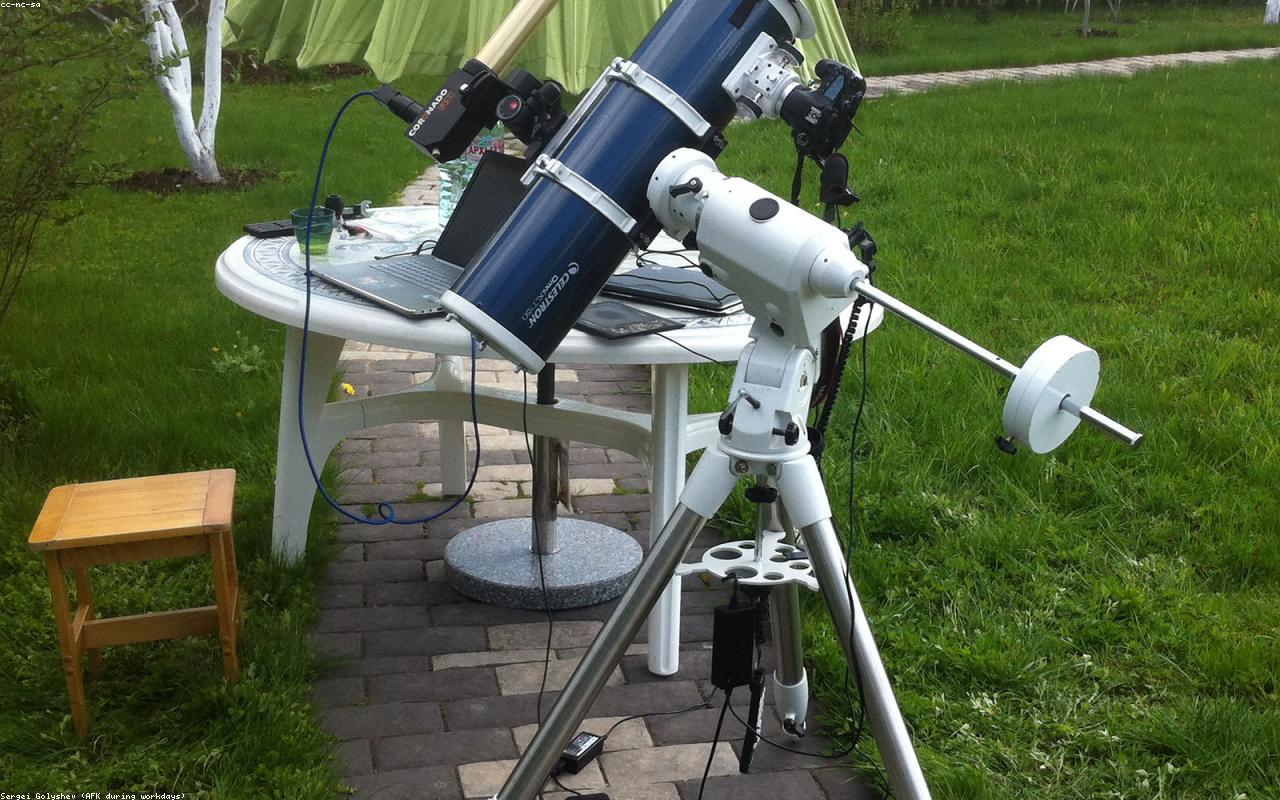
Her rig has evolved across the decade. In 2017 she used a Canon DSLR on a tracking mount with a 400mm lens. In 2024 she used a dedicated astrocamera, narrowband-filtered, on a smaller refractor, with all sequences pre-programmed in capture software.
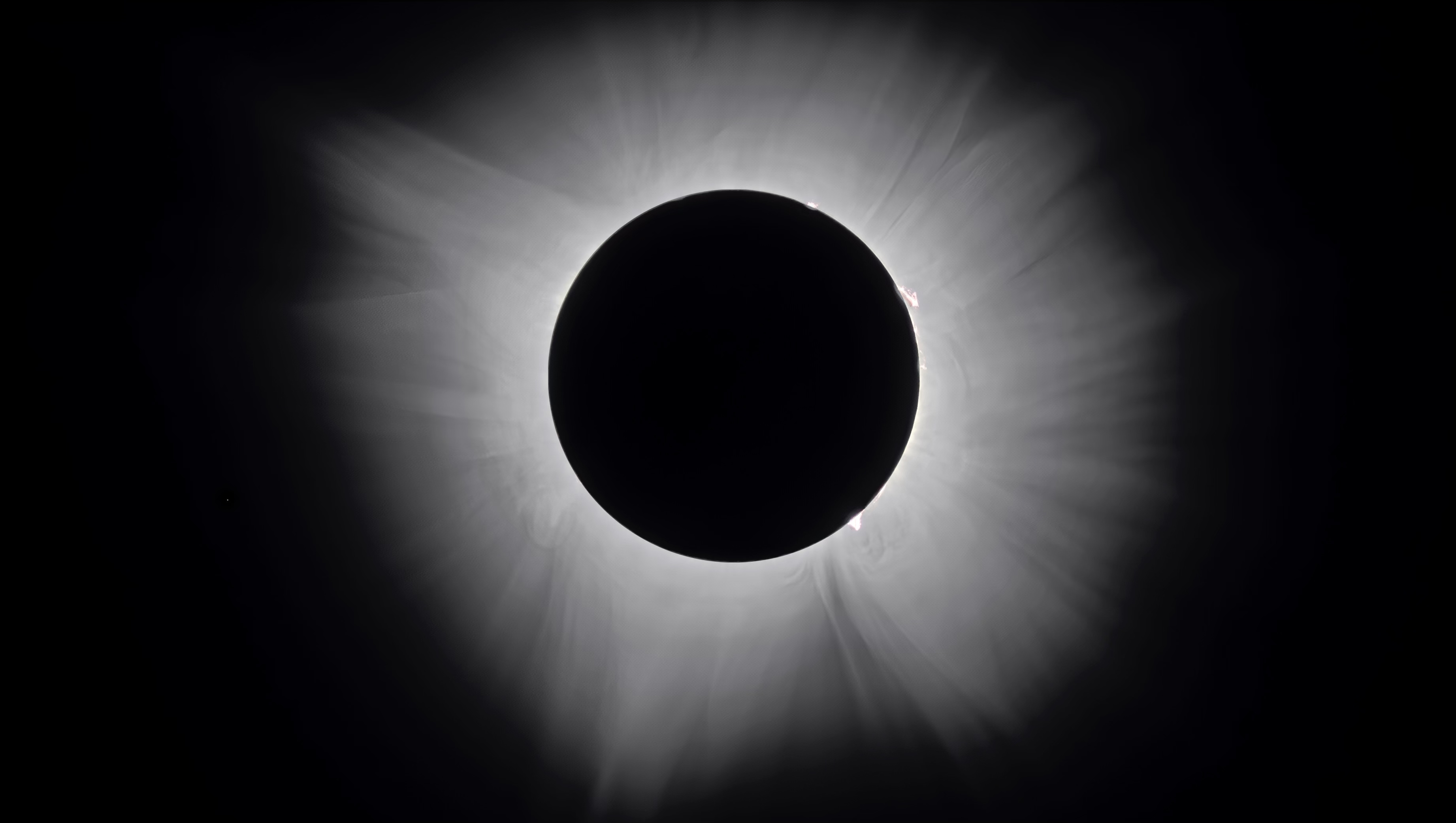
Her processing of the 2024 totality, combining 217 individual exposures into a single composite showing the corona's structure from the limb out past four solar radii, took her seven weeks. The image was published in the BAA Journal in October 2024.
Chen agrees with Lindholm that the photograph is not the eclipse. She finds the work meaningful anyway. The image is a record made for other people. The eclipse itself is something else.
Tomás Reyes Vidal lives in Cusco, Peru. He has observed five total eclipses, all from Latin America, and refuses to travel to others. His reasons are partly philosophical and partly economic. The high-altitude dry climate of his region gives some of the most reliable eclipse weather in the world, and several of the better recent paths have crossed within a day's drive of his home.
He goes with no equipment beyond a pair of eclipse glasses and a folding chair.
He has, he told Garcia in a long phone call, no need to record what he has seen. He remembers it. The remembering is sufficient and the equipment is, for him, an obstacle.
Three observers, three approaches. All three were quick to insist that other amateurs should not necessarily do as they do. The discipline is various enough to hold a wide range of practice.
The shared elements are smaller and more practical. All three plan their travel at least two years in advance. All three carry redundant copies of essential documents. All three observe Murphy's Law of Eclipses, which states that the equipment that has worked perfectly at home will fail in the field at minute T minus four.
All three carry spare batteries in inner jacket pockets, where the temperature stays warm enough to preserve charge.
The 12 August 2026 total solar eclipse will cross northern Spain, with totality lasting approximately one minute and forty-five seconds along the centerline near Burgos and Zaragoza. Lindholm has booked a small village near Reinosa, Cantabria, eighteen months in advance. Chen will be near Logroño with a group of seven photographers. Reyes Vidal will not travel.
The weather statistics for northern Spain in mid-August are generally favourable. Lindholm gives the probability of clear skies, based on twenty-year reanalysis, at approximately seventy percent for his chosen site. He has chosen a backup site forty kilometres east in case of unexpected cloud, and a second backup south, in case of a more general weather system.
Eclipse planning resembles emergency planning. The hope is that the contingencies will not be needed. The practice of having them is the discipline.
What is true of totality, all three observers agreed, is that it is brief. Two minutes is not long. One minute and forty-five seconds is shorter still. The observer who has not rehearsed which moments to spend on which observations, which equipment to attend to and which to let run, will spend most of totality fumbling.
The pre-totality rehearsal, done at home in the weeks before, is the single piece of advice all three give to new chasers. Block out the sequence by the second. Speak it aloud. Practice it standing at the actual mount with eyes closed.
Garcia ended each of her conversations the same way, with the same question. What was the moment, across all the eclipses you have observed, that you most remember?
Lindholm chose the 1991 Baja totality, his first, for the simple reason that he had nothing to compare it to. Chen chose the 2024 Texas totality, observed with her seventeen-year-old daughter beside her. Reyes Vidal chose a moment in 1991 also, on the Bolivian altiplano, when a flock of altiplano gulls flew over the observing site at second contact and made no sound at all.
Filed under