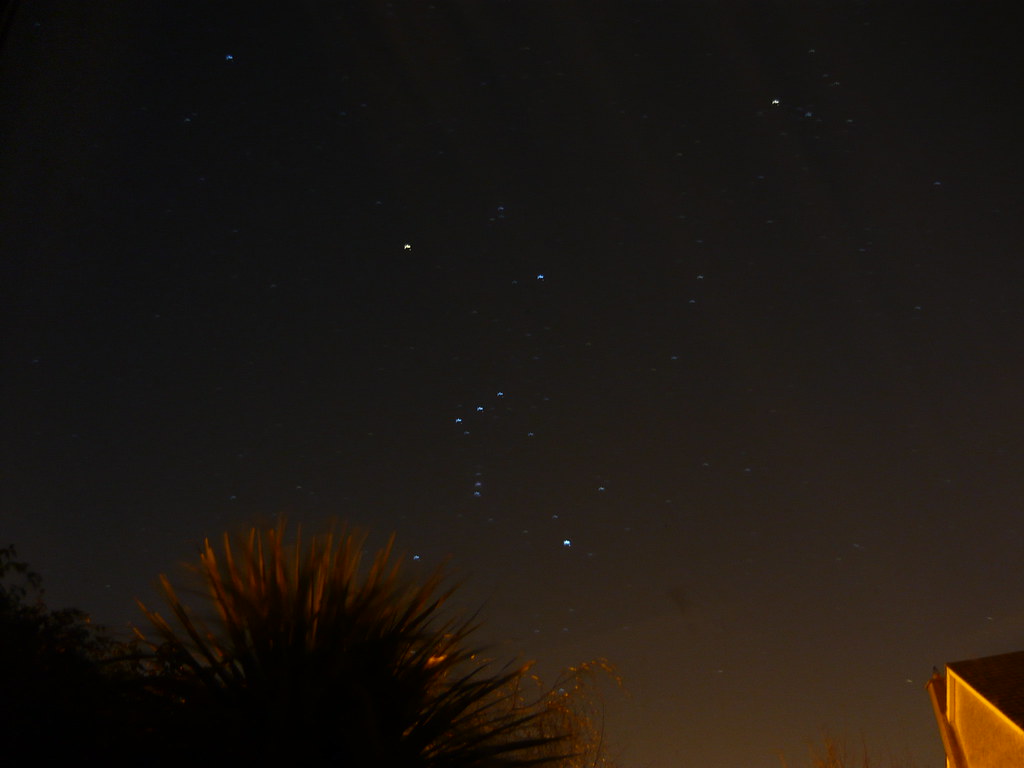
The Winter Hexagon is the largest of the named asterisms in the northern sky. It is built from six first-magnitude stars: Capella in Auriga, Aldebaran in Taurus, Rigel in Orion, Sirius in Canis Major, Procyon in Canis Minor, and Pollux in Gemini. Sometimes Castor is added to make a heptagon, but the traditional figure is six.
It is roughly fifty degrees across at its widest point, which is half the width of the sky from horizon to zenith. It takes up most of the visible heaven on a clear winter evening.
Hans Brunner, an amateur observer in Schaffhausen, Switzerland, who has kept a sky journal since 1982, says he did not see the Winter Hexagon as a single object until he had been observing for about a decade. He had known the constituent stars, and the constellations they belong to, for years. The pattern of the hexagon itself escaped him.
What changed was a winter evening in February 1992 when he stood in a friend's pasture outside Stein am Rhein and the friend, a non-astronomer, asked him what the big ring was. Brunner looked, and saw the ring for the first time.
This is a common experience among observers. The constellations are taught one at a time, often from charts that show only a few at once, and the larger relationships between them are seldom emphasized.
The Winter Hexagon corrects this. It is a pattern that crosses six constellations and binds them together. To see it requires standing back from any single constellation and taking in the whole visible sky at once.
The best night to begin learning the Hexagon is a clear, moonless evening in late January or early February, around 9 p.m. local time, from a location with an unobstructed view to the south. The asterism then rides high in the southern sky with its long axis running roughly east-west.
Capella, the brightest of the six, sits at the top. Pollux is to its lower left. Procyon is below Pollux. Sirius is at the bottom of the hexagon, the brightest star in the entire night sky, and unmistakable. Rigel sits at the lower right. Aldebaran completes the figure on the upper right, with its distinct orange colour.
Once seen, the Hexagon is difficult to unsee. Brunner says he can now walk outside in late January and find the figure within five seconds, and that the individual constellations within it look slightly less primary than they once did.
Inside the Hexagon, somewhat off-centre, lies Betelgeuse, the bright red-orange supergiant in Orion's shoulder. Some observers prefer to call Betelgeuse the heart of the hexagon. Others note that it is not actually centred and prefer to leave it as a notable interior feature.
The Hexagon is not a true astronomical grouping. The six stars are at wildly different distances from Earth, ranging from about eight light-years for Sirius to over six hundred for Rigel. They share no physical relationship. The pattern exists only from our particular point of view in the galaxy.
But this is true of every constellation. The constellations are patterns of perspective. The Winter Hexagon is simply a larger pattern of the same kind, and one that brings the brightest stars of the season into a single visual order.
For the beginning observer, learning the Hexagon is a useful intermediate step between learning individual constellations and learning the sky as a whole. It also serves, in the field, as a wayfinding tool.
An observer who has lost their place in the sky can almost always re-find Sirius, the brightest star visible at night, and from Sirius can trace the Hexagon upward and outward to reach any of the major winter constellations.
Brunner teaches the Hexagon to his nephews and nieces, when they are old enough to stand still in the cold for fifteen minutes, by asking them to count the six bright stars and to trace the figure with one finger held at arm's length.
He says the trick that finally works for most people is to stop trying to see the constellations first. He asks them to ignore Orion and Taurus and the others and to look only for the six brightest points of light in the south. Once these are identified, the connections between them become visible without further prompting.
By April, the Hexagon is sinking in the west and will be lost in evening twilight by early May. It returns in late October as a pre-dawn figure, climbs higher through November, and reaches its highest evening position around the end of January.
There are summer asterisms of comparable size, including the Summer Triangle of Vega, Deneb, and Altair, but the Summer Triangle is a smaller and simpler figure. The Winter Hexagon, with six stars and the bright interior of Betelgeuse, is the most complex and most beautiful of the seasonal asterisms in the northern sky.
Brunner says he expects to see the Hexagon another thirty winters, if he is lucky. He says that this is enough.
The Hexagon, like the sky in general, does not require anything of the observer. It is simply there, available, on any clear winter night, for anyone willing to step outside and look up.
Filed under