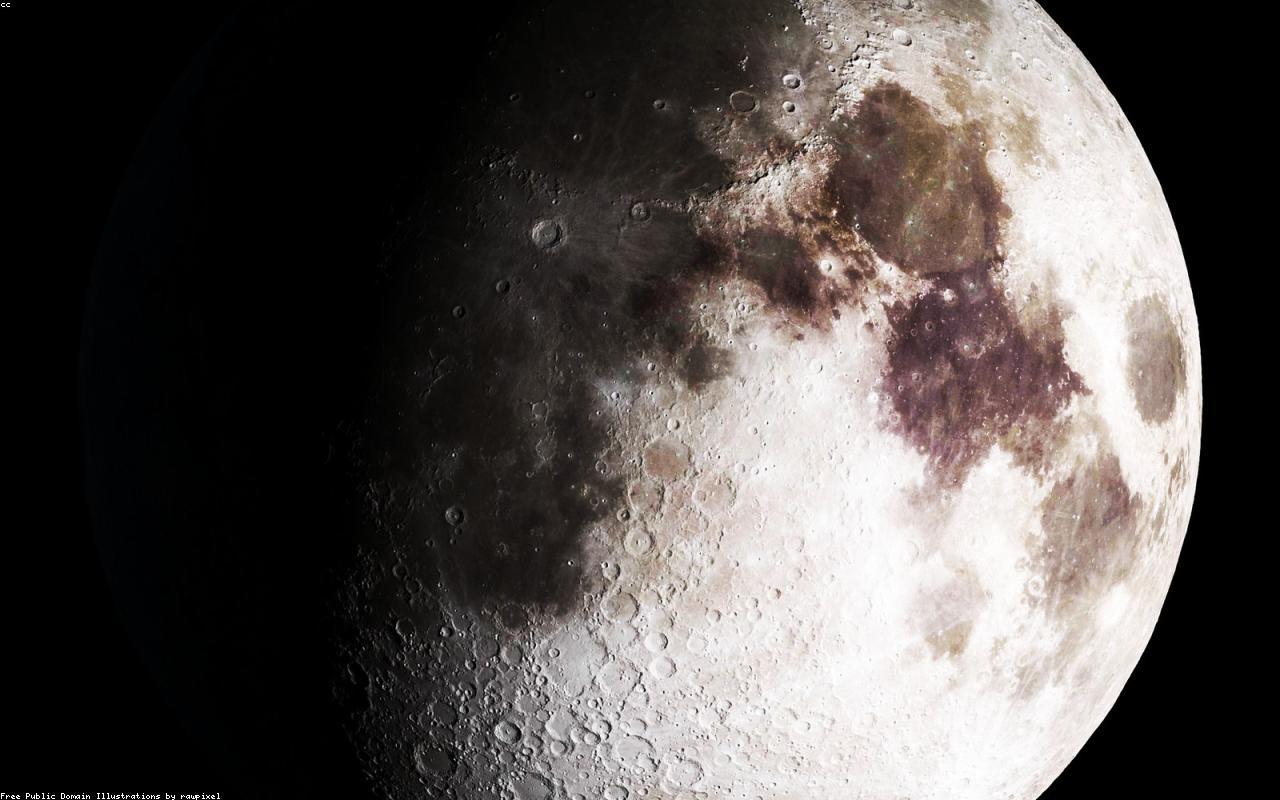
The Moon, in popular understanding, always shows the same face to Earth. This is true in the broad sense but false in the small one. Over the course of a synodic month, the Moon's visible face actually shifts slightly, exposing a thin band of additional terrain along the limb. This phenomenon is called libration.
Libration arises from three combined effects. The Moon's orbit is elliptical, so its rotational motion does not quite match its orbital motion across a month. The Moon's rotational axis is tilted relative to its orbital plane. And the observer on Earth, by virtue of being on the surface rather than at the centre, sees the Moon from slightly different angles as Earth rotates.
The cumulative effect is that an observer on Earth, over time, can see roughly fifty-nine percent of the Moon's surface, rather than the fifty percent that simple geometry would suggest.
Marco Vitale, a retired naval officer in Trieste, Italy, decided in April 2026 to observe and sketch lunar libration across a complete synodic month. He chose the period from April 27 to May 26, which spanned a full lunar cycle from new moon to new moon.
His equipment was modest: an 80mm refractor on an alt-azimuth mount, a single 10mm orthoscopic eyepiece for a magnification of 60x, a pad of unlined heavy paper, and a 4B pencil.
He set up each evening on his balcony, which faces east over the Adriatic and which has, by the standards of Italian coastal cities, a respectably dark horizon. He observed the Moon from whatever phase it presented and sketched the limb regions closest to the libration extremes.
On April 28, with the Moon a thin waxing crescent, libration in longitude was favorable for the eastern limb. Vitale could see, more clearly than usual, the dark floor of Mare Marginis along the eastern edge.
By May 4, near first quarter, libration in latitude was favorable for the southern limb, and Vitale sketched the rugged terrain around the crater Bailly, which is normally so foreshortened as to be difficult to recognize.
On May 11, near full moon, the libration was modest in both axes, but the high illumination made the limb regions difficult to study because of the absence of shadow relief. Vitale used the night to make a careful sketch of the central terra and noted that this was a poor evening for libration work.
By May 18, near last quarter, libration in longitude had swung in favour of the western limb. The crater Grimaldi, normally close to the limb but visible, was now displaced further from the edge, and the dark floor of Oceanus Procellarum was more fully revealed.
On May 22, libration in latitude favoured the northern limb. Vitale sketched the region around Mare Humboldtianum, which lies so far north that it is normally foreshortened into a thin ellipse but which now, briefly, appeared more circular.
Each sketch was dated, time-stamped, and labelled with the observed values of libration in longitude and libration in latitude, which Vitale calculated using a small program he had written for the purpose, drawing on the standard lunar ephemeris data.
By the end of the month, he had twenty-four sketches and a complete record of the libration cycle.
What the exercise demonstrated, to Vitale's satisfaction, was that the Moon is not the static object that most observers, even careful ones, assume. The face presents itself slightly differently every night. Features near the limb appear and disappear over the course of weeks.
Some of the features visible only at extreme libration are worth specific attention. The crater Einstein, for example, on the far side of the western limb, is barely visible at the most favourable western libration and entirely invisible the rest of the time.
Similarly, the southern crater Drygalski, named for a German geographer, requires a specific southern libration combined with appropriate phase to be seen at all.
Vitale developed, over the month, a particular fondness for the eastern limb feature Mare Smythii. It is a small dark patch that, at favourable libration, presents itself as a recognizable mare. At unfavourable libration, it is reduced to a thin sliver against the limb. He sketched it on six different nights and could see, in his own drawings, how much its appearance varied.
The exercise also taught him patience. There were three nights during the month when cloud cover prevented any observation, and one night when haze made the Moon a blurred disc with no useful detail. He could not, in those cases, make up the lost work. The Moon was at a particular phase and libration on those nights, and would not return to exactly that configuration for many months.
He had to accept the gaps in his record.
By the end of the synodic month, his sketches had improved noticeably. The early ones were tentative and somewhat schematic. The later ones showed more careful proportion, more accurate shadow placement, and more confident treatment of the libration regions specifically.
Vitale, who had not drawn anything seriously since his school days, said this was the unexpected gain of the project. He had learned, by drawing the Moon, to look at it.
He intends to continue the practice. He says he expects to spend the next two years filling a sketchbook with libration observations, and to begin, eventually, attempting to time the appearance of specific limb features against published libration ephemerides.
What lunar libration offers the amateur, in the end, is the same thing that the rest of astronomy offers: a closer look at something that seemed familiar, and the slow realization that it was never quite as fixed as it appeared.
Filed under