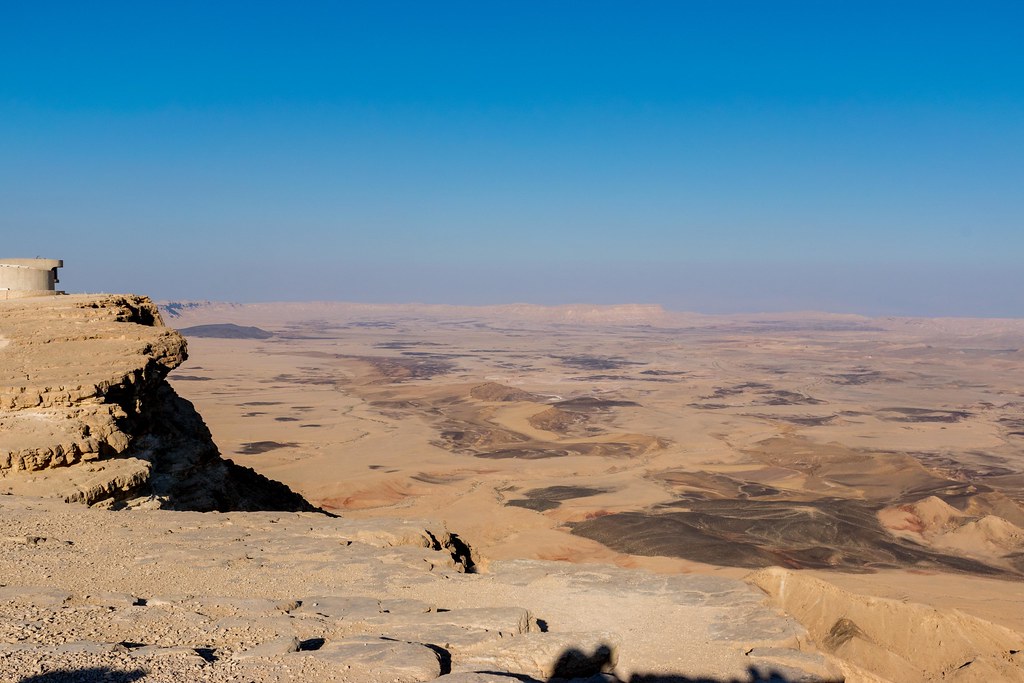
Mitzpe Ramon is a town of 5,200 perched on the northern rim of the Ramon Crater, a forty-kilometre erosion makhtesh in the central Negev. The rim sits at 880 metres. The crater floor drops another 400 metres below it. The town has one main road, one supermarket, and three restaurants that open in the evening.
On the night of 4 April 2026, a school group of nineteen children from the Atid Beersheva science magnet school arrived at the Ramon Mizpor observation deck at 21:40. They were accompanied by two teachers and the writer of this piece.
The deck sits 400 metres west of the town's main visitor centre and is, by careful design, almost entirely dark. The walkway is lit by a single shielded amber strip along the floor. There are no overhead lights at all. The handrail is reflective.
Three telescopes had been set up by Yochanan Pinhasov, who runs the small Ramon Astronomy Outreach Centre and who was the group's host for the evening. A 12-inch Newtonian, an 80mm apochromatic refractor, and a pair of mounted 25x100 binoculars.
The first task, Pinhasov said, was to let the children's eyes dark-adapt. He spent twelve minutes explaining the visible constellations using only a faint red flashlight pointed downward. The children, who had ranged from giggly to bored on arrival, gradually grew quiet.
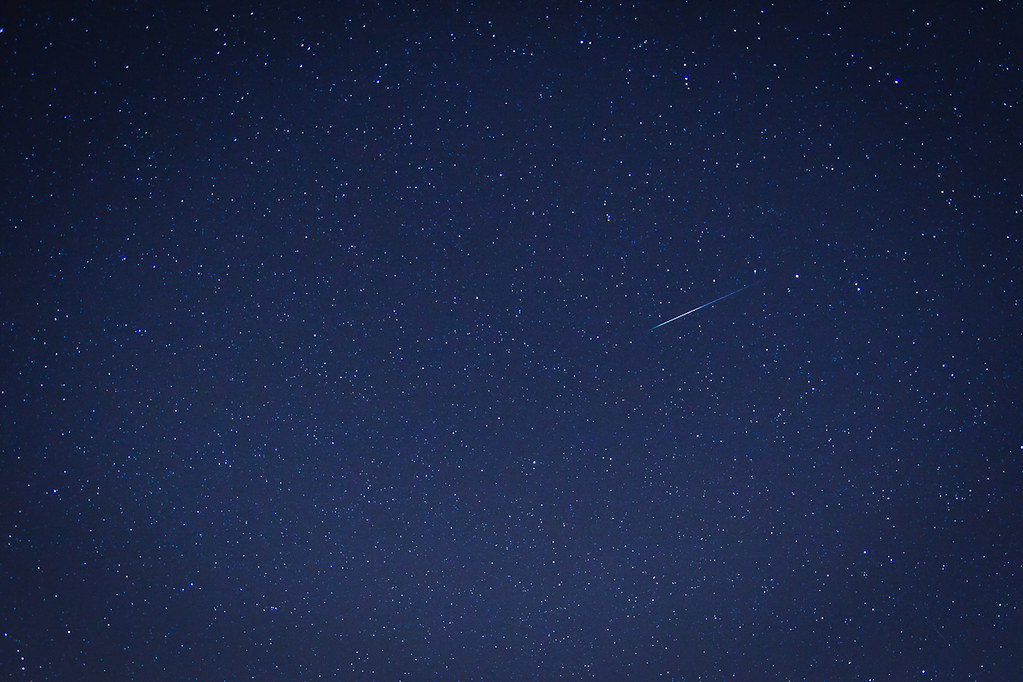
At 21:58 Pinhasov asked the children to look straight up. The first observable Milky Way detail of the night, the dark Cygnus Rift, was visible to the unaided eye as a tear in the bright band. Three children, in different parts of the group, asked simultaneously what the dark line was.
The SQM reading taken at 22:14 by Pinhasov was 21.71 magnitudes per square arcsecond. He has logged readings from this point since 2017 and his long-term mean for clear spring nights is 21.65.
Mitzpe Ramon was certified as an International Dark Sky Community in November 2017. The certification followed several years of work by the town's municipality, which had retrofitted its streetlamps with warm amber LEDs in a programme completed in 2015.
The municipality's motivation, by the account of former mayor Roni Marom, was partly aesthetic and partly economic. The town had recognised that astrotourism was a growing sector and that the town's location, on a wide-rim site with almost no surrounding development, was a competitive advantage that could be eroded by careless lighting.
It has not been eroded. The skyglow from Dimona, sixty kilometres to the northeast, is visible on still nights as a faint dome on the horizon. The skyglow from Beersheva, ninety kilometres north, is faintly detectable on sensitive instruments but not to the unaided eye.
The school group spent ninety minutes at the telescopes. The 12-inch Newtonian showed the Orion Nebula, then the Beehive Cluster in Cancer, then a globular cluster, M3 in Canes Venatici, that drew an audible reaction from two of the older children.
The 80mm refractor was dedicated to lunar work — the moon was a thin crescent low in the west — and to a careful look at the open cluster M44. The binoculars stayed on the Milky Way band through Cygnus and Aquila.
By 23:30 the school group was beginning to flag. Two children were asleep on the deck, wrapped in blankets brought by the teachers. Pinhasov ended the formal observation and the group walked the short distance back to their bus.
The crater itself is invisible at night, except as an absence. The horizon on the south side simply drops away into black. On a still night the silence is complete; there are no insects in March, no birds in the dark, no road noise. The only sound, near the deck, is the slight hum of an electrical transformer at the visitor centre.
After the group left, Pinhasov stayed out with the writer until 02:30. The zodiacal light, which is unusually prominent from this latitude, was visible by 23:00 as a broad cone along the ecliptic in the west.
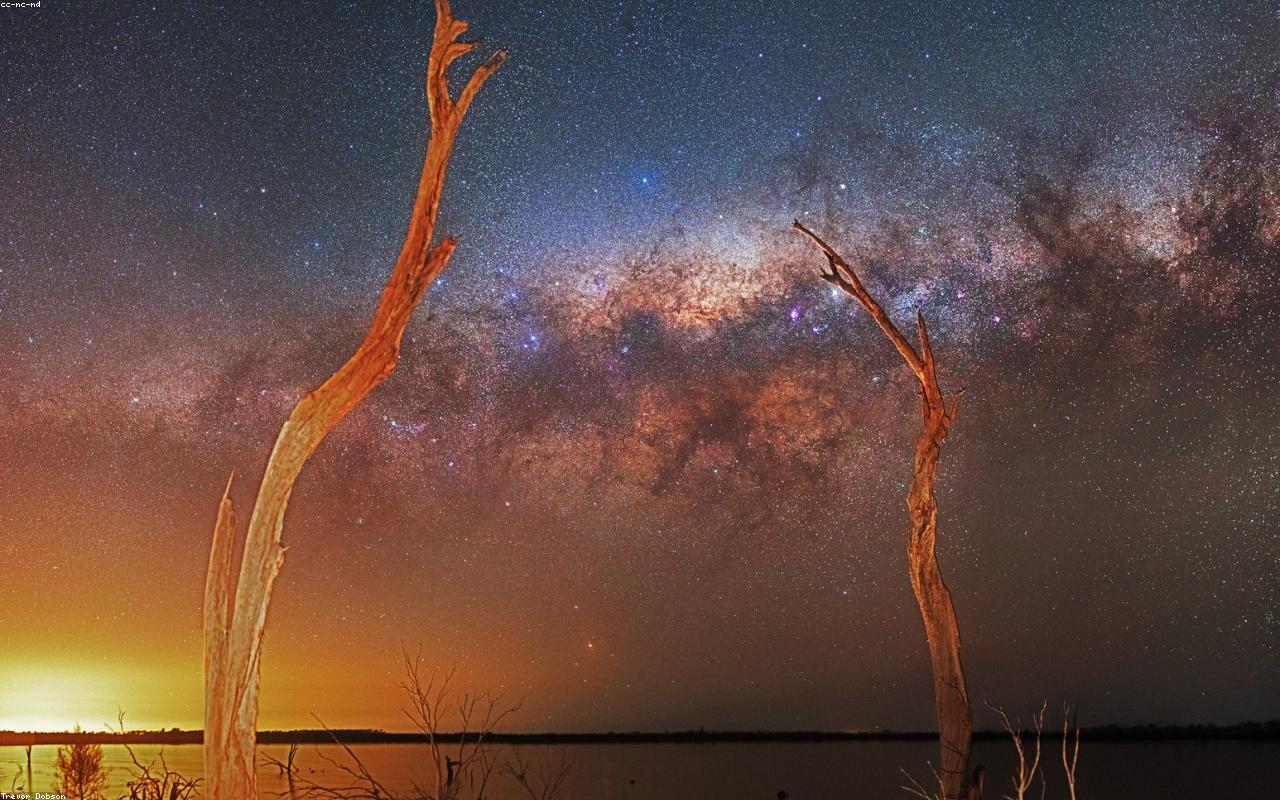
At 01:40 the Milky Way's central bulge began to climb above the southeastern horizon, behind the towers of the Wise Observatory at Mount Misgav, twelve kilometres south. Through binoculars the dust lanes in Sagittarius were sharply resolved.
The Wise Observatory, operated by Tel Aviv University, is the largest professional observatory in the immediate area and is, in part, why the town has remained committed to its lighting policy. The observatory's data quality depends on it.
Pinhasov took his last SQM reading of the night at 02:14: 21.74. Marginal improvement over the early-evening number. He attributed it to the falling temperature, which had stabilised the atmosphere, and to the moon having set.
Asked whether the town's commitment to dark-sky preservation was secure, Pinhasov was cautious. The municipality, he said, has supported the work consistently. New developments, including a controversial proposed hotel on the eastern rim, will be the next test. He hopes the planning committee remembers the readings.