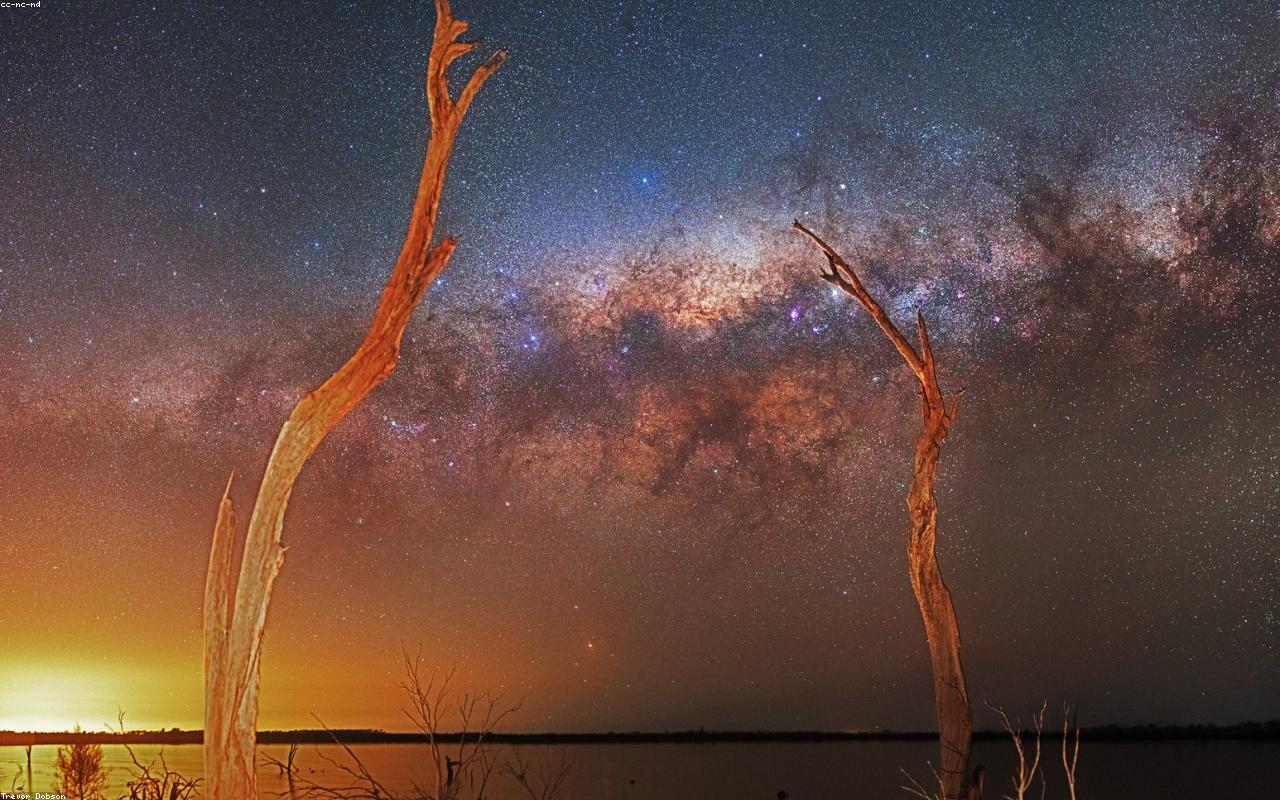
The Aoraki Mackenzie International Dark Sky Reserve was certified in June 2012, covering 4,367 square kilometres of the Mackenzie Basin in New Zealand's South Island. At the time it was the largest dark-sky reserve in the world. As of 2026 it remains the largest in the southern hemisphere.
At its centre, on a hill above the town of Lake Tekapo, sits the Mount John University Observatory, run by the University of Canterbury. The observatory hosts five research telescopes and a thriving public astrotourism programme that receives, in a typical year, around 95,000 visitors.
On the night of 18 May 2026, Last Light joined the observatory's small-group astronomy tour. The tour is run by Dark Sky Project, a private operator that holds the public access concession from the university. Sixteen visitors, two guides, three telescopes, and a temperature on the summit of minus four degrees.
The summit road climbs 320 metres above the lake in five kilometres of narrow switchbacks. The university restricts access at night; only the tour operator's vehicles are permitted up after sunset. The restriction protects both the working observatory and the dark-adaption of the visitors.
The lead guide for the evening was Hari Tane, a former school physics teacher from Christchurch who has worked for the operator for nine years. His introductory talk lasted seventeen minutes and covered the constellations of the southern winter sky, the geography of the reserve, and the basic operation of the telescopes available.
The southern winter sky is the great compensation for visiting the Mackenzie Basin in cold weather. The Magellanic Clouds, both Large and Small, are at their best altitude. The galactic centre rises high in the south. The Southern Cross sits nearly upright in the evening sky.
On the night of the visit, the SQM reading at the summit observation deck, taken at 19:42, was 21.92 magnitudes per square arcsecond. The long-term mean for this site, recorded by the university's monitoring programme since 2012, is 21.85.
The first telescope of the tour was a 16-inch Meade Schmidt-Cassegrain on a permanent pier, dedicated to deep-sky work. Tane's first target was 47 Tucanae, the magnificent southern globular cluster in the constellation Tucana. At low power the cluster filled a third of the eyepiece field. The visitors took turns over four minutes each.
The second target was the Tarantula Nebula in the Large Magellanic Cloud. Through the 16-inch, with an OIII filter, the nebula's filamentary structure was visible in remarkable detail. One visitor, a Dutch tourist who said she had observed the Tarantula from La Palma the previous year, said the view at Mount John was distinctly better.
The reserve's status is the result of more than a decade of preparation. The Mackenzie District Council had passed a lighting ordinance in 1981, originally to protect the working observatory rather than for any broader dark-sky purpose. The ordinance pre-dated the modern dark-sky movement by two decades.
By the time the reserve was certified in 2012, the ordinance had been amended several times to keep pace with lighting technology. The current version, last revised in 2019, sets shielding requirements, colour-temperature limits, and curfew provisions for all six of the basin's small towns.
Lake Tekapo, the largest of the towns, has a permanent population of 466. Twizel, on the southern edge of the basin, has 1,690. The towns are small enough that compliance with the ordinance is essentially universal. Non-compliant fixtures are rare and, when reported, are usually resolved with a phone call.
The reserve's challenges are largely external. The town of Geraldine, 110 kilometres east, has grown by roughly thirty percent since the reserve was certified. Its skyglow is detectable from sensitive instruments at Mount John, though not yet to the unaided eye.
The proposed expansion of the airport at Tekapo, debated in 2024 and currently on hold, would have introduced new runway lighting that the reserve's coordinators considered a significant threat. The proposal's pause is, by some accounts, partly attributable to local resistance from the astrotourism sector.
By 22:00 the temperature on the summit had fallen to minus seven degrees. The visitors were warm in down jackets supplied by the operator and, in two cases, in hand warmers tucked into gloves. The wind had stayed calm all evening, which Tane described as unusual for May.
The third telescope, a 16-inch Dobsonian, was wheeled out for the final hour. Its main target was the Carina Nebula complex, low in the southwest. Through the eyepiece, the eta Carinae region showed the famous Keyhole structure with striking contrast.
Tane took his final SQM reading at 22:18: 21.94. He had also taken an intermediate measurement at 21:00, which had been 21.89. The slight darkening through the evening tracked the temperature drop, which had brought the atmosphere to a more stable state.
The tour ended at 22:45. The visitors descended in two vans. The writer, with permission from the observatory, stayed on the summit for an additional ninety minutes with Tane, who was on duty until midnight.
By 23:30 the galactic centre in Sagittarius and Scorpius had climbed into the eastern sky. Through 10x50 binoculars, the dark dust lanes were unusually sharp, and the Lagoon Nebula, M8, was a clear naked-eye object. Tane mentioned, with some satisfaction, that he never quite gets used to it.