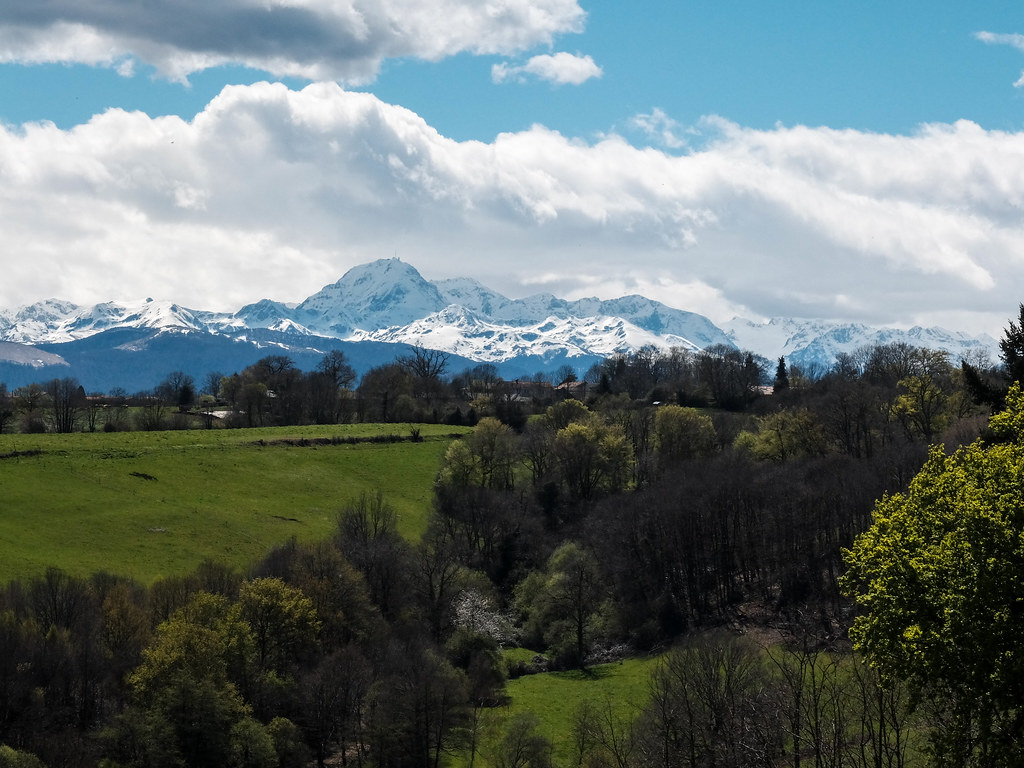
The Pic du Midi de Bigorre rises 2,877 metres above the Adour valley in France's Hautes-Pyrénées. The summit has been a working astronomical observatory since 1878. It also currently hosts a small heritage hotel that takes a maximum of fifteen overnight visitors at any time.
The site is reached by a 15-minute cable car from the village of La Mongie, itself a ski resort at 1,800 metres. The cable car operates year-round, weather permitting, and is the only practical means of access for the general public. The summit is on the Pyrenean ridge and is not connected to the road network.
On 22 May 2026 Last Light took the last cable car of the day up to the summit at 18:30 and stayed until the first cable down the following morning. The hotel that night had thirteen overnight guests. The dinner was served at 20:00 in a small dining room with windows facing east.
The Pic du Midi sits at the centre of the Réserve Internationale de Ciel Étoilé du Pic du Midi, certified by the International Dark-Sky Association in December 2013. The reserve covers 3,112 square kilometres of the central Pyrenees, including the Néouvielle massif and parts of the Pyrenees National Park.
The certification was driven by the working observatory's need for dark sky. The observatory's primary current instrument is a one-metre telescope, the Télescope Bernard Lyot, which has been in continuous operation since 1980. It is used principally for stellar spectropolarimetry.
The site also hosts the Coronograph Lyot, a heritage instrument designed by Bernard Lyot himself in the 1930s, which made the first systematic observations of the solar corona outside of eclipses. The Coronograph is, in 2026, still occasionally used for educational demonstrations.
After dinner the overnight guests gathered on the south observation terrace, the Terrasse des Coronographes, which is reserved for hotel guests after sunset. The terrace is unlit. The handrails are reflective. The temperature at 21:00 was four degrees Celsius and the wind was light from the southeast.
The on-site astronomer for the evening was Laurent Ferreyra, who has worked at the Pic du Midi as a guide and observer for fourteen years. He set up two telescopes on the terrace: a 250mm Dobsonian and a 130mm apochromatic refractor. The hotel maintains a small fleet of guest instruments.
The first half-hour was spent on the visible naked-eye sky. Ferreyra pointed out that the dome of skyglow from Toulouse, 150 kilometres to the north, was just visible on the northern horizon as a thin amber line below Polaris. Lourdes, 30 kilometres to the northwest, contributed a smaller, brighter glow that was more local in extent.
Apart from these two domes, the horizon was almost entirely dark. The towns of Bagnères-de-Bigorre and Lannemezan, both within thirty kilometres, contributed negligibly. The reserve's lighting retrofitting programme, run jointly with the Parc National des Pyrénées, has reached most of the affected communes.
At 22:00 Ferreyra took an SQM reading from the south terrace: 21.83 magnitudes per square arcsecond. His long-term mean for clear spring nights from this site is 21.79. The night was a touch better than average.
The targets through the 250mm Dobsonian began with M13, the great globular cluster in Hercules, high in the eastern sky. Through a 13mm eyepiece the outer halo of the cluster was clearly resolved into individual stars, and the brighter members of the core showed the characteristic propeller pattern.
The second target was M51, the Whirlpool Galaxy, in Canes Venatici. Both spiral arms were visible. The bridge between M51 and its companion NGC 5195 was clearly visible. One visitor, a retired engineer from Antwerp, said it was the best view of M51 he had ever had.
The 130mm refractor was used for wide-field work. Ferreyra centred it on the Coma Berenices star cluster, then on the Beehive in Cancer, then on the Pleiades, which were already low in the west. The refractor's image was sharp and high in contrast, with no chromatic fringing on bright stars.
At 23:00 the wind picked up briefly to about 15 knots. Ferreyra moved the telescopes to the eastern side of the terrace, in the lee of the Lyot dome. The wind dropped again by midnight.
Most of the guests went to bed by midnight. Three remained on the terrace, including the writer of this piece, until 02:30. Ferreyra stayed with them, partly because the Lyot Telescope was in operation that night and he was, in a quiet way, on call.
The Milky Way through Cygnus was at its best by 01:00. The dark Cygnus Rift was sharply defined. The Veil Nebula complex was visible through the 250mm Dobsonian with an OIII filter, both the eastern and western arcs, in remarkable detail.
Ferreyra took his final SQM reading at 02:14: 21.86. A small improvement over the early-evening number, consistent with the deepening of the atmospheric inversion below the summit. The valley below was now solidly under a sea of cloud, visible by starlight as a pale level surface 1,000 metres beneath the terrace.
Sleep at the Pic du Midi is brief and irregular. The hotel rooms are small, the corridors are stone, and the first cable car down departs at 09:00. The writer of this piece slept three hours and woke at 06:00 to watch the sunrise from the eastern observation deck.
The Pic du Midi is, among other things, an experiment in whether a working observatory and a public-access hotel can share a fragile summit. So far, by Ferreyra's account and by the testimony of the SQM record, the experiment has worked. The visitors come, the science continues, and the sky remains dark.