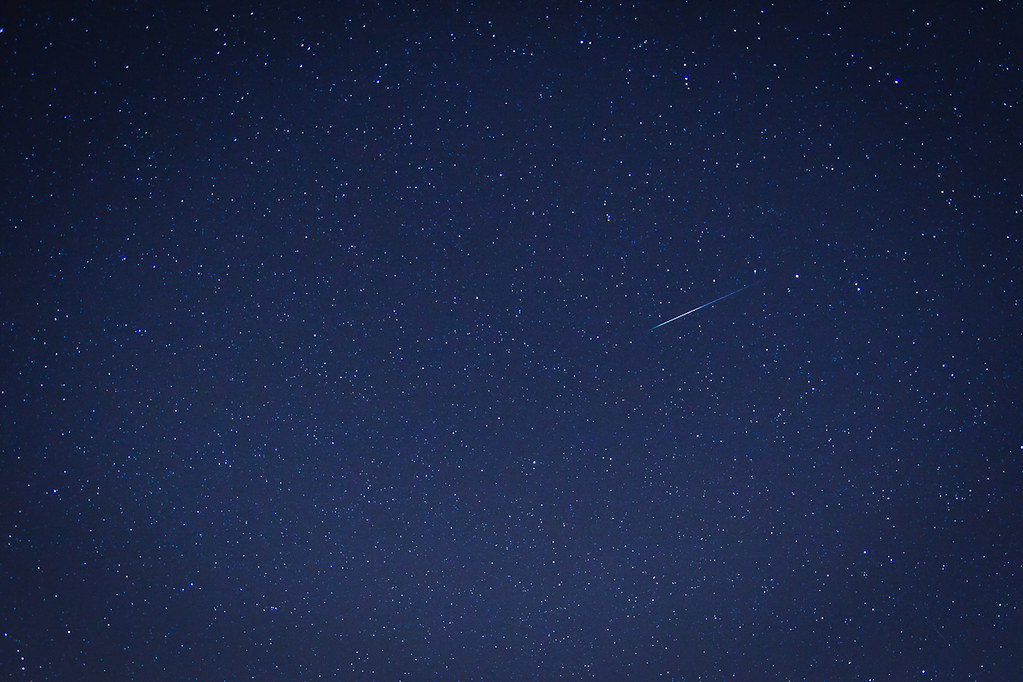
On the roof of a small house in the Munich suburb of Pasing, an upward-pointing fisheye camera has photographed every clear night sky for the last six years. The camera belongs to Anselm Bauer, and it is station number 234 in the European Fireball Network.
The amateur meteor camera, as a category of equipment, has matured from a hobbyist curiosity into a serious scientific instrument in the past decade. The leading networks — FRIPON in France, UKMON in the United Kingdom, AMS Fireball Network in North America, and the European Fireball Network across the continent — now process automated detections from over four thousand amateur stations.
The science these networks produce is substantial. Triangulation between multiple cameras allows the calculation of fireball trajectories with sufficient accuracy to predict meteorite landing zones, and several recovered meteorites of the last decade — Flensburg in 2019, Winchcombe in 2021, Ribbeck in 2024 — were located using amateur camera triangulation.
Bauer's station was installed in November 2019 at a cost of roughly four hundred and fifty euros. The hardware consists of an IP security camera fitted with a 1.55 mm fisheye lens, a small single-board computer to handle detection and storage, and a weatherproof housing that mounts on a standard satellite dish bracket.
The software is the free RMS package developed by the Croatian Meteor Network and adopted by the Global Meteor Network. RMS handles image capture, automatic detection, trajectory calculation, and submission to the central network database.
The detection algorithm runs in real time on the single-board computer and identifies meteor candidates by their characteristic linear motion across successive video frames. False positives — aircraft, satellites, lightning, insects — are filtered automatically with reasonable but not perfect accuracy.
Bauer's station detects, on a typical clear night, between twenty and eighty meteors. During major shower peaks the count can rise above two hundred. The detections are uploaded to the Global Meteor Network server within minutes of capture.
The triangulation that makes the network scientifically useful requires at least two cameras observing the same meteor from sites separated by approximately one hundred kilometres. The geometry is generous — a meteor at typical altitude can be seen from camera stations across a region several hundred kilometres wide.
Bauer's station regularly triangulates with stations in Salzburg, Augsburg, Regensburg, and Innsbruck. In favourable cases a single bright meteor can be captured by ten or more cameras across central Europe, producing an extremely well-constrained trajectory.
The most significant fireball observed by the Munich station in its operational life was the event of 19 January 2025, the same fireball that produced the four hundred and twelve eyewitness reports described in this column last month.
The Pasing camera captured the entire trajectory in clear weather, contributed to a six-station triangulation calculated by FRIPON, and helped localise the residual mass to the Tegernsee region. The amateur network's work, on that night, was indistinguishable in quality from a professional one.
The equipment cost has declined steadily. A complete RMS station can today be assembled for between three hundred and five hundred euros, depending on the choice of camera and computer. The Czech Hydrometeorological Institute distributes complete pre-assembled stations to amateurs in central Europe for a similar cost.
The site requirements are modest. A clear view of the sky above approximately thirty degrees elevation in most directions is sufficient. A rooftop, a garden shed, or an apartment balcony with a southern exposure can all host a productive station.
The single most important practical decision is whether to commit to running the station continuously. The networks rely on consistent operation — a camera that is offline for the peak night of a major shower contributes nothing to that shower's analysis.
Bauer's station has run, in its six years of operation, with approximately ninety-three percent uptime. The seven percent downtime accounts for software updates, the occasional power failure, and one extended outage in August 2023 when a thunderstorm took out the single-board computer.
The networks are increasingly international in their cooperation. A meteor that begins over France, traverses Belgium, and terminates over the Netherlands will today be triangulated by stations from all three national networks within hours of its occurrence.
This level of automated cross-border cooperation, Bauer notes, was unimaginable a decade ago. It depends on shared software, shared data formats, and a small community of volunteer coordinators who have done the unglamorous work of standardisation.
The amateur meteor camera, in Bauer's reading, has reached the stage that amateur photographic patrol cameras reached for variable stars in the 1990s — the stage at which the amateur's data is no longer supplemental to the professional's but is, in the relevant subdiscipline, the primary scientific record.
Bauer's recommendation, for any reader with a south-facing roof, a power outlet within reach, and a willingness to leave a small black box running through the night, is to install a station. The networks need coverage, the science benefits from density, and the cost is now within reach of any household.
The Pasing camera, he writes in closing, has photographed every meteor over Munich for six years that any human happened to look up and see. It has also photographed several thousand that no human saw. Both kinds, he notes, are part of the record now.