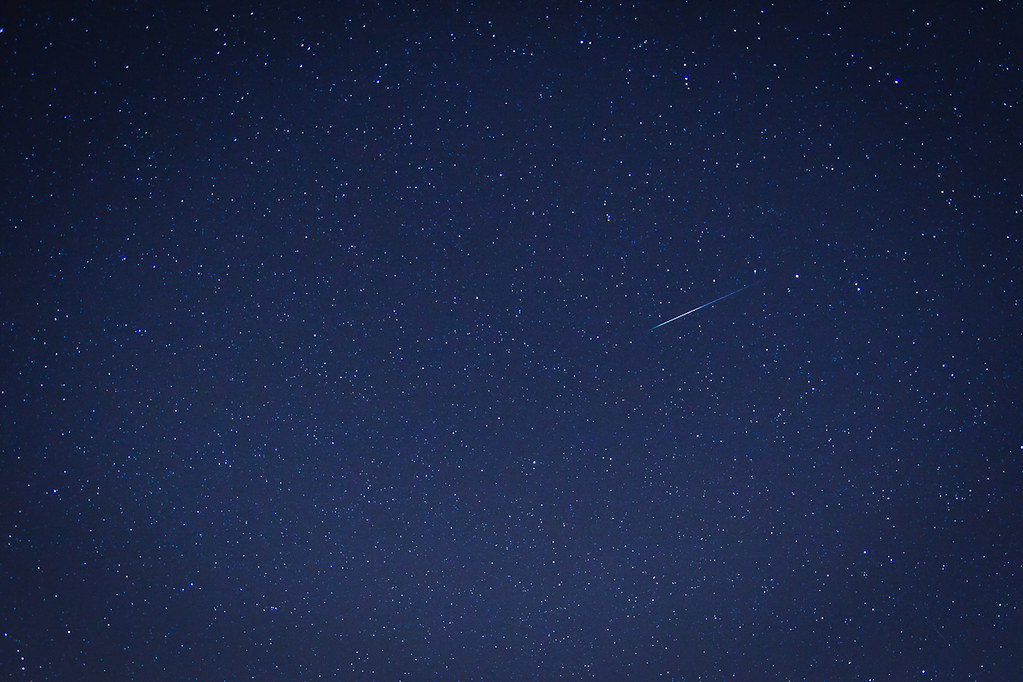
On the evening of 19 January 2025, at 18:24 Central European Time, a fireball brighter than the full moon crossed the sky over southern Bavaria from northwest to southeast. Within ninety minutes the American Meteor Society had logged four hundred and twelve eyewitness reports across six countries.
Anselm Bauer, who happened to be walking from his front gate to his car when the fireball appeared, submitted report number forty-seven from his phone before he reached the driver's seat.
The fireball was eventually catalogued as event 257-2025 by the IMO and as event 351-2025 by the AMS. Its calculated terminal point placed the residual mass — if any survived — in a forested area near Gmund am Tegernsee.
A search by the Naturkundemuseum Bayreuth in the following weeks recovered nothing. This is the typical outcome. Most fireballs leave no meteorite, and most that do leave fragments too small to find without snow on the ground.
What Bauer wants the casual observer to understand is that the report matters even when the meteorite does not appear. The triangulation of multiple eyewitness reports, even imperfect ones, allows researchers to calculate the fireball's atmospheric trajectory and, in favourable cases, its pre-encounter orbit.
The pre-encounter orbit is the prize. It tells us where in the solar system the rock came from, and it adds a single data point to our growing catalogue of small-body delivery from the asteroid belt.
The practical mechanics of fireball reporting begin in the first ninety seconds. The observer's memory of direction, brightness, duration, and end-point degrades rapidly after the event.
Bauer's recommendation is to step inside, open the AMS or IMO website, and submit a report within five minutes of the sighting. The form takes about three minutes to complete.
The most important fields are location of the observer, direction of first appearance, direction of last appearance, and time. Brightness, colour, fragmentation, persistent train, and audible sound are useful but secondary.
Location should be given as accurately as possible. A street address or a set of coordinates from a phone is ideal. Outside my house is, in Bauer's experience, the most common and least useful location report.
Direction should be reported as a compass bearing if the observer is confident, and as a landmark direction if not. The fireball appeared over the church spire and disappeared behind the white house on the corner is a useful report, because the directions can be reconstructed from the observer's address.
Brightness is conventionally compared to known objects. Brighter than the full moon is a significant event. Brighter than Venus is the threshold for fireball classification. An ordinary Perseid is roughly the brightness of Sirius, which is not a fireball.
Duration is almost always overestimated by inexperienced observers. A typical fireball lasts two to four seconds. An observer who reports ten seconds is usually wrong.
Colour and fragmentation should be reported only if the observer is certain. Many fireballs appear white to the human eye, and the perception of colour varies significantly between observers in the same event.
Audible sound is rare but real. A fireball bright enough to produce a sonic boom is a significant event, and any report of audible sound should be flagged in the report's free-text field.
Persistent train — a glowing trail that lingers for seconds to minutes after the fireball has passed — is one of the most diagnostic features of a major event. It is also the easiest feature for the observer to record on a phone camera, even after the fact.
Bauer reminds readers that two networks, the AMS in North America and the IMO in Europe, share data and that a report to either is, in effect, a report to both. The Fireballs Worldwide form on the AMS website is the most widely used international entry point.
The reports of ordinary people, walking out to their cars or carrying out the rubbish, are the irreplaceable data source for fireball science. There is no automated network dense enough to replace them.
Bauer's gentle observation, after twenty years of amateur reporting, is that the fireball you remember most clearly is the one you reported. The act of writing down what you saw is itself a way of seeing it.