In the spring of 1886, at Armagh Observatory in the north of Ireland, a Danish-born astronomer named John Louis Emil Dreyer wrote to the Royal Astronomical Society and offered to undertake a single piece of work that would consume the next two years of his life.
The offer was a revision of Sir John Herschel's General Catalogue of Nebulae and Clusters of Stars, published in 1864 with five thousand and seventy-nine entries. Dreyer had already produced a supplement to it, in 1878, containing one thousand one hundred and seventy-two additions. Now, faced with the rapid expansion of the field, he proposed to merge everything into one volume.
The Society agreed. The result, published in the Memoirs of the Royal Astronomical Society in 1888, was the New General Catalogue of Nebulae and Clusters of Stars. It contained seven thousand eight hundred and forty entries. It is the source of every NGC designation in modern use.
Dreyer was thirty-four when the work was completed. He had been director at Armagh for four years and would remain there for thirty-two more. He kept a habit, throughout the compilation, of cross-checking every entry against at least two independent observation records and, where possible, against a recent visual confirmation from one of his correspondents.
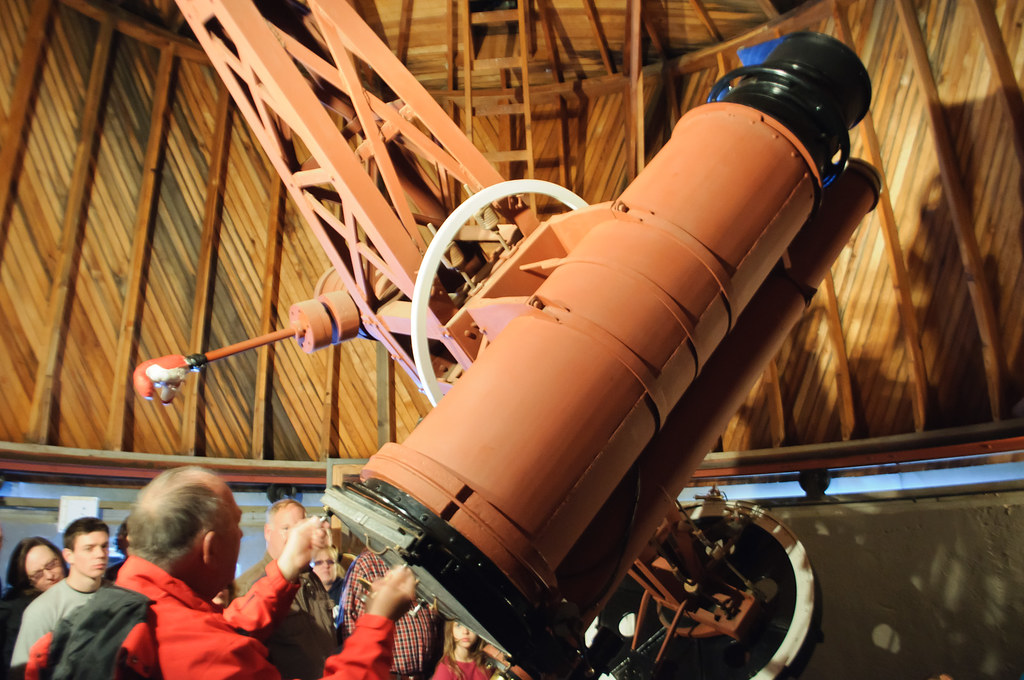
He had a great deal to cross-check. The original Herschel catalogue drew chiefly on the work of William Herschel, conducted between 1782 and 1802 with a series of reflecting telescopes culminating in the famous forty-foot at Slough. William had observed nearly two and a half thousand nebulae from his back garden. His sister Caroline had compiled the lists.
John Herschel, William's son, had extended the work between 1825 and 1838, observing from the Cape of Good Hope in order to bring the southern sky into the same scheme. He returned to Slough in 1838 with notes for some seventeen hundred southern nebulae, which the General Catalogue absorbed.
By the 1870s, however, the introduction of larger telescopes, particularly Lord Rosse's seventy-two-inch Leviathan at Birr Castle and the great refractors at Lick and Pulkovo, had begun to fill in detail the Herschels could not have seen. Spiral structure had been resolved in M51 in 1845. New nebulae were being reported faster than they could be tabulated.
Dreyer's solution was bureaucratic and a little ruthless. He requested every observing notebook he could obtain. He read them in three languages. He standardised positions to the equinox of 1860.0. He gave each object a sequential NGC number running in order of right ascension. Where two observers disagreed about an object's existence, he noted both views and assigned a single best estimate.
Some of his decisions have not aged well. NGC 4794, for instance, turned out on later inspection to be an internal reflection in the eyepiece of an observer in Birr. NGC 1990, near the belt of Orion, was a long-running cataloguing artefact that astronomers chased for nearly a century before concluding it does not exist.
These errors are rare. The NGC's overall accuracy is, at the level of position to within an arcminute, somewhere above ninety-six percent. For a compilation from notebooks kept in candlelight, transmitted by post, and translated by one man working without a typewriter, this is remarkable.
Dreyer published two supplements, the Index Catalogue of 1895 (5,386 entries, designated IC) and a second Index Catalogue of 1908 (1,529 more). Together with the NGC, these form a corpus of nearly fifteen thousand objects that remained the working catalogue of nebulae and clusters for most of the twentieth century.
The replacement, when it came, did not so much supersede the NGC as supplement it. The Revised New General Catalogue by Sulentic and Tifft, published in 1973, corrected positions and added cross-identifications. The NGC/IC Project, an amateur effort initiated in 1993, has spent thirty years tracing every entry to its original observation and noting discrepancies.
Wolfgang Steinicke's Revised New General Catalogue and Index Catalogue, first issued in 2009 and updated several times since, is now the working reference. It preserves every NGC number, corrects roughly six percent of them, and adds notes on each object's true nature, often distinguishing between Herschel's nebula and what modern instruments reveal.
What modern instruments reveal is, of course, far beyond Dreyer. Gaia's third data release, in 2022, included positions and parallaxes for nearly two billion sources. The Sloan Digital Sky Survey, in its various incarnations, has imaged a third of the sky in five filters and produced a catalogue of nearly half a billion objects.
And yet when amateurs at a star party in Cherry Springs or in the Atacama point a telescope at a smudge of light and want to know what they are looking at, they call the smudge by Dreyer's number. NGC 4565 is still the Needle Galaxy. NGC 6960 is still the western half of the Veil.
The NGC's persistence is partly inertia. It is also a tribute to the care with which Dreyer assembled it. He understood that a catalogue is a contract between the people who made it and the people who would, in some future century, want to find an object again.
Armagh Observatory holds his working papers. They show a small, neat hand, in pencil and in ink, with marginal cross-references in three colours. The ink is iron gall. The paper is acidic and is browning at the edges. The numbers, however, remain legible.
Dreyer himself wrote, in the introduction to the 1888 volume, that the catalogue was not a final work but a foundation on which others might build. He hoped, he said, that future astronomers would find his errors and correct them, and would not blame him too severely for the ones he had failed to catch.
He has, in this, been generously treated. The NGC has been corrected steadily for one hundred and thirty-eight years. It has also been used, in those years, by more astronomers than any other catalogue in history except possibly the Bayer designations of 1603 and the Henry Draper.
There are not many nineteenth-century scientific compilations that can make the same claim. The Royal Society's Catalogue of Scientific Papers, an inventory of journal articles published between 1800 and 1900, is now consulted chiefly by historians. The Encke ephemerides are obsolete. Even the Bonner Durchmusterung has been retired in favour of digital surveys.
The NGC remains in use. It remains in use because it was good enough. It was good enough because one man at a small observatory in Armagh spent two years writing down what other people had seen, and because he did so with the assumption that someone, somewhere, would one day need to look it up.