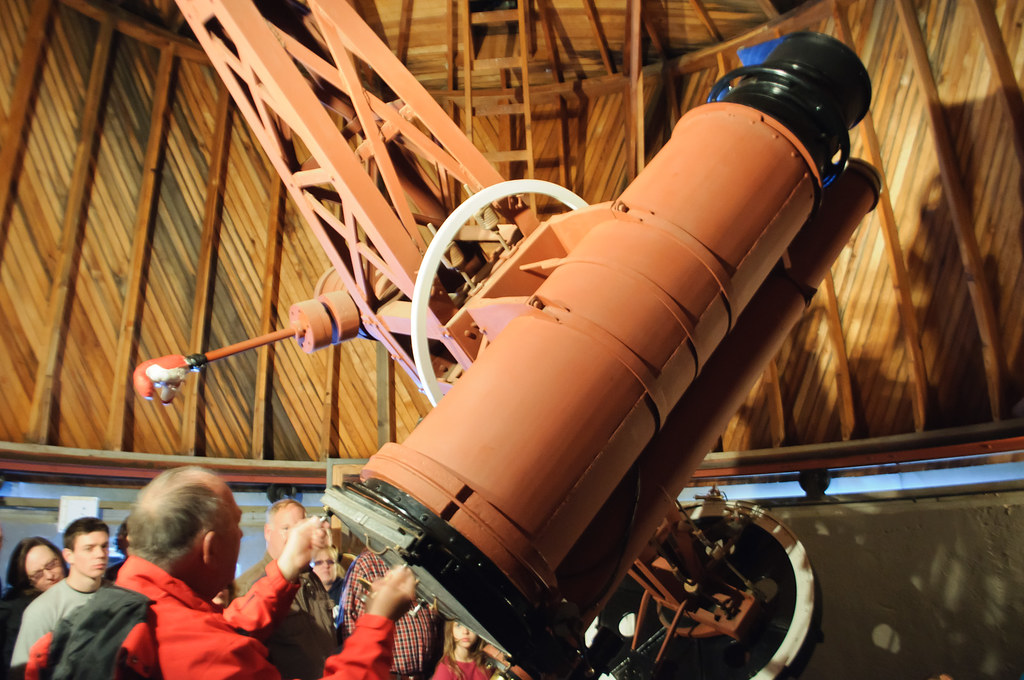
At 6:47 p.m. on Friday, March 27, 2026, an amateur astronomer named Cal Whitfield set up an eighteen-inch Dobsonian on a gravel pad at the McDonald Observatory's public viewing area, in the Davis Mountains of west Texas. He was the first of fourteen observers to arrive. By 7:15 the others were assembled.
The plan, agreed in advance over an email thread that had been running since November, was to attempt the Messier Marathon, a sustained dusk-to-dawn observation of all one hundred and ten objects in Charles Messier's 1781 catalogue of nebulae and clusters.
The Messier Marathon, as a tradition, dates to the 1970s. The marathon window opens for roughly two weeks around the spring equinox, when the Earth's orientation makes it just possible, from a latitude near 30 degrees north, to see every Messier object in a single night.
The window opens at sunset, when M77 in Cetus must be caught low in the west before it sets, and closes at dawn, when M30 in Capricornus must be observed rising in the east just before the sky brightens. In between, the observer has roughly ten hours of darkness in which to work through the remaining one hundred and eight objects.
The McDonald site is at an elevation of 6,790 feet, in the southern reaches of the Davis Mountains, about an hour's drive from the small town of Fort Davis. The sky there is rated Bortle 1 to 2 across most of the dome, which is to say it is among the darkest skies in the contiguous United States.
The fourteen observers had come from across the state. Five from Austin, three from Houston, two from El Paso, two from Lubbock, one from San Antonio, and one from a small town called Marfa, which is forty miles south.
They had brought, between them, eight Dobsonians ranging from ten to twenty-five inches in aperture, three Schmidt-Cassegrains, two refractors, and one large pair of mounted binoculars. The binocular observer, a retired engineer named Marisol Vega, intended to attempt the marathon entirely with naked-eye work and 25x100 binoculars.
The list was distributed in printed form. It followed the conventional marathon order, which begins with the evening setters in Pisces and Cetus and works east through the night, ending with the dawn risers in Sagittarius and Capricornus.
Whitfield began at 7:32 p.m. with M77, the spiral galaxy in Cetus, caught at an altitude of just over fifteen degrees. He confirmed the object visually with a 25 mm Nagler eyepiece, then moved to M74 in Pisces, which is widely considered the most difficult of the marathon objects because of its low surface brightness.
He had it by 7:48. He moved next to M31, M32, and M110 in Andromeda, all of which he resolved at low power before 8:05.
By midnight Whitfield had observed seventy-four objects. He was working at his planned pace. He took a fifteen-minute break at 12:30 a.m. to eat a sandwich and to refill his thermos with coffee.
At 2:10 a.m., during the long sequence of globular clusters in Sagittarius and Scorpius that occupies most of the middle hours of a marathon, the temperature dropped to 38 degrees Fahrenheit and a thin layer of high cloud began to move in from the southwest.
The cloud thickened. Between 2:45 and 3:20 a.m., three of the fourteen observers gave up. Two of the three said they were satisfied with sixty or so confirmed objects and that they were not willing to spoil their night by chasing the dawn list under poor conditions.
The third, a graduate student from Houston named Priya Aravind, said simply that she had been observing for nineteen hours and would prefer to sleep.
By 3:45 the cloud had cleared. The remaining eleven observers worked through the dawn list in a long, patient sequence: M14, M10, M12, M107, M9, M19, M62, the globulars rising in Ophiuchus and Scorpius, then the Sagittarius cluster of star clouds and nebulae.
M55 was observed at 4:32. M75 at 4:48. M72 and M73 in Aquarius at 5:14 and 5:16. M2 in Aquarius at 5:31. M15 in Pegasus at 5:42.
M30 in Capricornus, the traditional last object, was caught by Whitfield at 6:11 a.m., low in the east, against a sky that was already beginning to brighten with civil twilight. He sketched it briefly in a pocket notebook, confirmed the central condensation, and packed up the eyepiece case.
Eleven of the fourteen observers completed the marathon. Vega, with her binoculars, observed ninety-six of the one hundred and ten, missing only the faintest galaxies in Virgo and Coma Berenices, which she said she would attempt again next year with a small telescope.
The completion rate, by McDonald's informal records, is roughly average. The marathon is not, as a project, particularly difficult for an experienced observer with a moderate telescope and a dark site. It is, however, demanding in a quiet way: it requires preparation, attention, and the willingness to stand in the dark for ten hours doing essentially the same thing over and over.
Whitfield, who is forty-seven and is a high-school physics teacher in Austin, has now completed the marathon four times. He says the appeal, for him, is not the achievement but the pace. The marathon obliges the observer to move at a steady working rhythm through the sky, neither dwelling on any one object nor skipping any.
It is, he says, a way of reading the catalogue end to end. He compares it to reading War and Peace in a single sitting, which he has not done, but which he understands would have a similar effect on the reader's sense of what the work is.
The Messier catalogue is not War and Peace. It is a list of nebulous objects compiled by a French comet-hunter in the 1770s for his own convenience. But it is a list with an order, and the marathon gives that order a shape, and the shape, observed once a year on a single cold night in the Davis Mountains, is something that a small number of people in Texas now look forward to.